Saturday, 3 June 2017

Tesla Powerwall

Benefited by its cutting-edge battery technology, the famous electric sports car maker, Tesla, has expanded its business to the residential energy market by introducing the Powerwall system.

The latest generation of Powerwall 2 can be installed either on the wall or under the floor, and provides 13.2 kWh of storage using the lithium-ion batteries set.
Although it is said that the Powerwall system is the trend of sustainable energy, or is supposed to be a perfect match of the solar panel system. I am barely convinced on how the batteries can be a sustainable saviour of our daily life.
The Powerwall is fairly expensive. The estimated cost including installation is around $10,000, or $15,000 if bundled with solar panels. Even with a long ten-year warranty, the payback term is estimated to be 1.5 to 3 times of the warranty period. I.e., under the best situation, if the system keeps running without any decay and break down, your investment can only be returned in 15 years.
On the other hand, the batteries only store energy generated by the solar panel, or from a off-peak cheaper tariff. Once the power is generated from the solar panel, storing it in the battery or selling it back to the grid does not change its sustainable fact. The Powerwall system may help to save some peak power usage, however such benefit is fully eliminated by the expensive initial cost.
We all understand the sustainability of a product should be evaluated over the full life cycle, while the production and disposal of battery is never the cleanest business in the world. Spending tens of thousand dollars on a system that may eventually break even, to me, does not worth the environmental damage to produce and recycle such large amount of batteries.
Powerwall, it may be a possible self-supporting solution for rural areas with no power grid. However, looks more like an expensive fashionable toy for people with deep pockets rather than sustainability pursuit.
http://reneweconomy.com.au/battery-price-war-sees-tesla-powerwall-2-beaten-even-before-first-deliveries-44252/

Bike sharing service – patching the last kilometre gap of the public transports?

Underground public transportation, such as the metro, is obviously the best solution for remitting the traffic congestions in the metropolis. It’s quick, on-time and has sufficient capacity, however, unlike the buses, the metro stations are generally sparser. The distance between the destinations and the closest station is often around or more than one kilometre.

Like many other public services, the coverage to the last kilometre is either expensive or not feasible to be supported. However, to the public transport commuters, the last kilometre is a bit far to walk however too close to justify the time and cost of calling a cab.
Bicycle sharing is a new business model emerged and expanded in China recently, and it is designed to provide a cheap and convenient transport method for the last kilometre issue.

The Mobike, the biggest and initiative company of the bicycle sharing, has received large amount of investments, and have deployed hundreds of thousands special designed bicycles close to the metro stations in capital cities. Unlocking a bike requires only one scan from the app installed in smart phone, and the rate is set at 0.5 or 1 Yuan RMB (10 or 20 Australian cents) per half hour.

All Mobike bicycles equip GPS tracker, electronic lock and unique QR code for scan to unlock. The convenience and high-tech properties make Mobike extremely welcomed by Chinese commuters, and it also seems to be much more environmental friendly than the car sharing business (Uber). Although the company has not made real profit during the initial expansion, this seems to be a good idea that contributes to a sustainable smart city.

https://qz.com/942372/mobike-one-of-chinas-top-bike-sharing-startups-is-now-paying-users-to-ride-its-bikes/


Aquaponics

Fertiliser has been widely used for growing plants from farms to the backyard garden bed, however many negative environmental effects may be caused, such as pollution to the water, soil acidification etc. In recent years, a prevailing symbiotic system that integrates the aquaculture and hydroponics became a successful sustainable solution for scalable organic food production.
An aquaponics system grows fish and plants together by implementing a micro eco-system. The high level of ammonia in the fish tank water is unhealthy for the fishes, however this is a nutrition-rich resource for growing plants. The water is continuously recirculated between both systems, and is cleansed and fertilising the plants by passing the roots in the hydroponics system. The aquaponics system use 10% of the water required for soil-based gardening, and even less water for the aquaculture system because no discharge is required.
I find the aquaponics system is very interesting because this is a self-supporting system requires very little maintenance. According to many reports, plants grow faster than in a traditional garden and the running cost is neglect as a small water pump is the only energy consuming device in a well-designed system. The good scalability and low cost makes this not only a solution for developed country such as Australia, but can also be a safe food source in the less developed areas as both animal protein and vegetable can be harvested from the same setup.


https://www.theaquaponicsource.com/what-is-aquaponics/


Smart bin for better recycling?

I have seen enough people getting confused on which bin their garbage should go, yellow or red. The general rules are easy to understand however many items are still in a vague area. An interesting “smart bin” named Eugene was crowdfunded in French last year, and it’s supposed to make the decision easier.
Eugene can scan the barcode of the package, then do a search on whether the material is recyclable, and guide the user place the rubbish in to the right bin. Sounds really something smart, hi-tech and, errrh, sustainable, doesn’t it?

One may get enough satisfaction from scanning the garbage one by one on this $450+ (299 euros) hi-tech bin and feel good for contributing to the environment, but is that true?
In order to get things correctly sorted, you have to buy processed foods, groceries and everything with a barcode, generally these are plastic packages. What about your fresh fruits, vegies or newspaper? Besides the expensive price you have paid for the bin itself, it consumes power, internet and multiple servers runs 24x7 for identifying the barcodes. Barcode cannot suggest what is a good recycling manner, the bin won’t remind you to clear your food from the package or wash your milk bottle before disposal.
And most importantly, a “smart bin” does nothing smart to reduce the rubbish, it may even encourage you to scan and dump rather than think carefully of reuse. At the end of the day, the bin itself becomes a big chunk of electronic rubbish, which is known to be the most unwanted landfill.
In summary: the smart bin is a useless modern toy which contributes nothing to the sustainability issue. Spending the same amount of money on else activity can do much better for the whole world. For those really can’t classify rubbish, there are mobile apps essentially have the same function to scan the barcode for you.

https://www.engadget.com/2016/10/13/smart-trash-can-helps-educate-reluctant-recyclers/#/

Monday, 26 August 2013

PROJECT ONE : KIOSK @ BOUNDARY

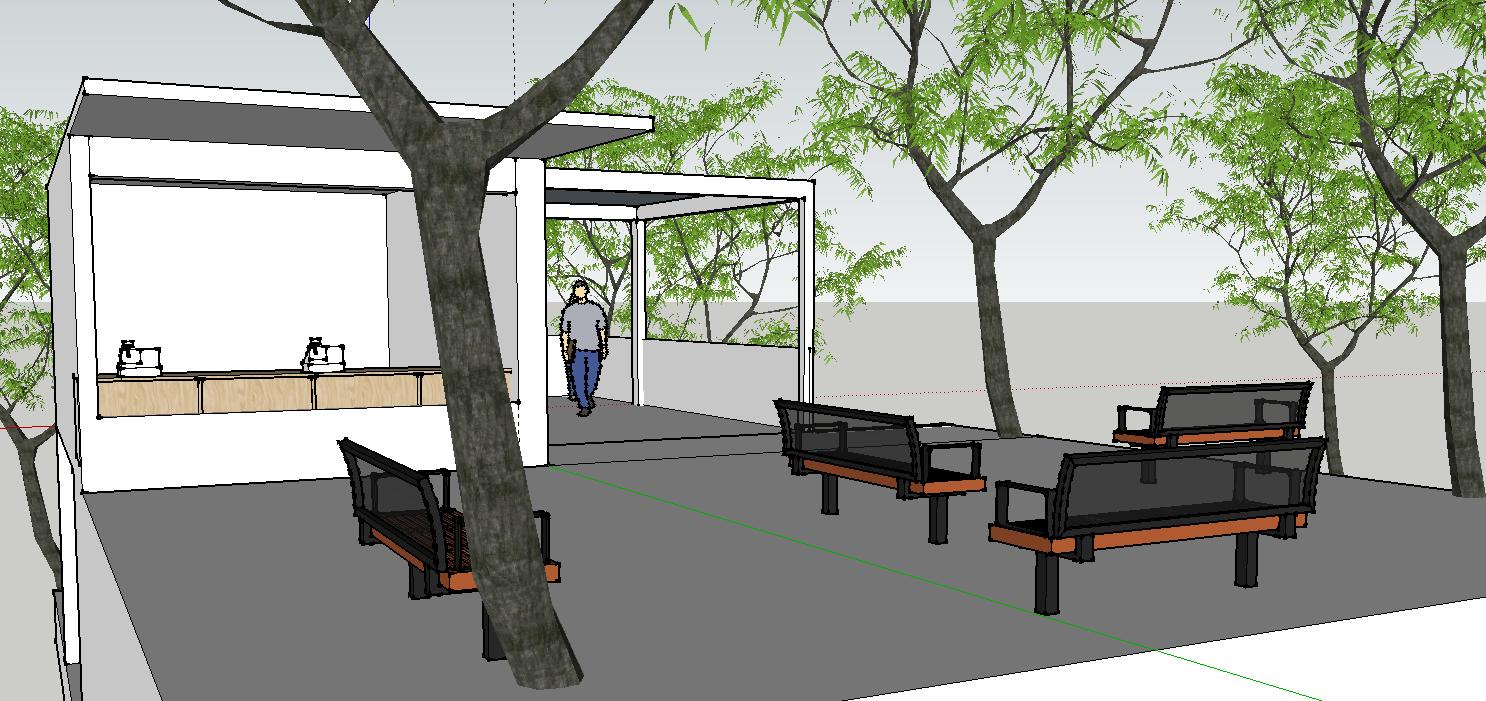
The design of the kiosk is two rectangle sets on both levels, and it consists four different spaces – two indoors and two open spaces. The room on the first level is a small kiosk, and the undercover space is 4m x 5m. There are two small rooms for storage and garbage behind the kiosk (both 2m x 2m). The upper level has an art supply and another undercover space. There are two toilets behind the art shop on the second level. And the material for the whole design is timber.

3D View 


PHOTO OF THE KIOSK MODEL


DESIGN DRAWINGS


Friday, 21 June 2013

EXP 3: Environment


Yellow Mountain


 Huangshan (simplified Chinese: 黄山; traditional Chinese: 黃山; pinyin: Huángshān; literally "Yellow Mountain"), is a mountain range in southern Anhui province in eastern China. The range is composed of material that was uplifted from an ancient sea during the Mesozoic era, 100 million years ago. The mountains themselves were carved by glaciers during the Quaternary. Vegetation on the range is thickest below 1,100 meters (3,600 ft), with trees growing up to the tree line at 1,800 meters (5,900 ft).
The area is well known for its scenery, sunsets, peculiarly shaped granite peaks, Huangshan Pine trees, and views of the clouds from above. Huangshan is a frequent subject of traditional Chinese paintings and literature, as well as modern photography. It is a UNESCO World Heritage Site, and one of China's major tourist destinations


Mountain in Cryengine


Add caption